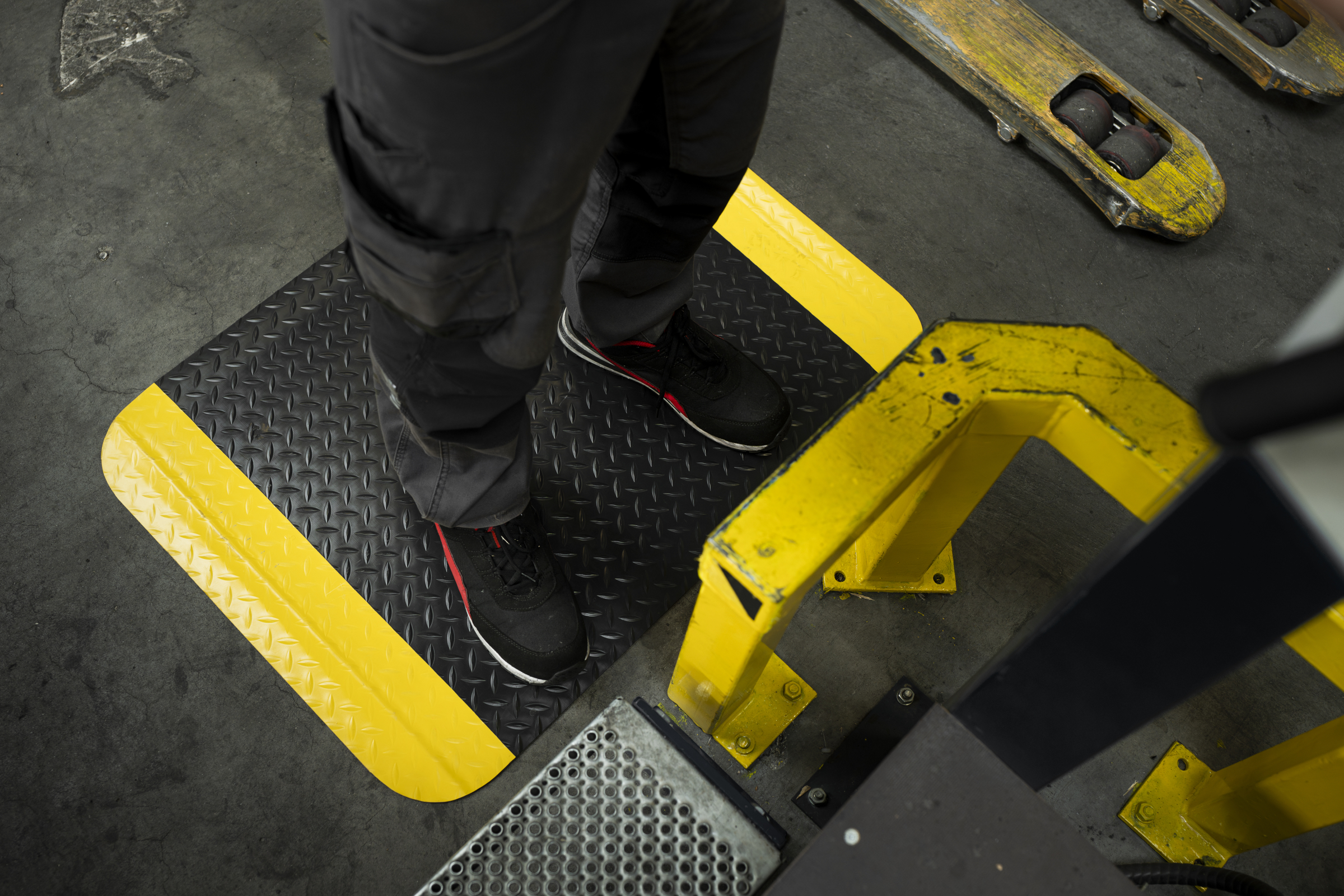
What does standing all day do to your feet and back?
What can you do about it?
What happens to your body when standing for long periods
When you stand still for hours, blood circulation in your legs is impaired. Normally, active leg muscles act as a pump to transport blood back to the heart. When standing still, this pumping action is largely lost, causing blood and fluid to pool in the lower legs and feet. This explains why feet often feel swollen at the end of a shift..
In addition, when standing still, the same joints ankles, knees, hips, and lower back continuously bear the body’s weight. Without any variation in posture or movement, the pressure on these points remains constant, eventually leading to fatigue, muscle tension, and sometimes chronic complaints.
Research into work-related musculoskeletal disorders, conducted by TNO (Netherlands Organisation for Applied Scientific Research), shows that factors such as repetitive movements, awkward working postures, high work pressure, and the exertion of force contribute significantly to the risk of occupational musculoskeletal disorders, including lower back pain and hip or knee osteoarthritis. Prolonged standing on a hard, flat surface is among these risk factors, especially when combined with a lack of postural variation.
Impact of the floor
An often underestimated factor is the surface one stands on. Concrete, tiles, and industrial flooring are extremely hard and offer no cushioning whatsoever. Every step or shift in weight is transmitted directly back to the joints and muscles, rather than being absorbed.
That is a major difference compared to walking on grass or sand, for instance, where the surface gives way and absorbs some of the impact. On a hard work floor, that natural effect is entirely absent unless something is placed between the feet and the floor that does offer a bit of give.
What helps with complaints caused by standing work?
There are various ways to reduce the strain associated with standing work:
Change position frequently.
Even small movements, such as shifting your weight from one foot to the other, keep blood circulation flowing better than standing completely still.
Suitable footwear.
Shoes with sufficient cushioning and support reduce the direct impact on the feet and ankles.
Build in short breaks.
Sitting or walking for a moment interrupts the constant strain and gives muscles a chance to recover.
Using an anti-fatigue mat.
These mats are specifically designed to allow for minimal, controlled muscle movement. That slight flex keeps blood circulation flowing better and reduces direct pressure on the joints compared to standing still on a completely flat, hard floor.
Of these measures, an anti-fatigue mat is often the easiest to implement systematically, as it requires no behavioral change from the employee; the mat does the work, regardless of whether someone is actively thinking about changing their standing posture.
Not every workplace requires the same solution.
The right approach depends on the work environment. Behind a checkout or counter, a thinner, comfortable mat is often sufficient. In a workshop where oil or moisture is present, a combination of cushioning and slip resistance is more important. In such cases, it makes sense to look for mats tested for both shock absorption and anti-slip properties (for example, according to the R-rating in DIN 51130), ensuring that both comfort and safety are addressed.
In short
Foot and back pain after a day of standing is not an inevitable consequence of the job, but a direct result of how the body reacts to prolonged, static loading. Small adjustments to posture and footwear help, but a structural solution such as a well-chosen anti-fatigue mat tackles the problem at its source: the surface being stood upon.