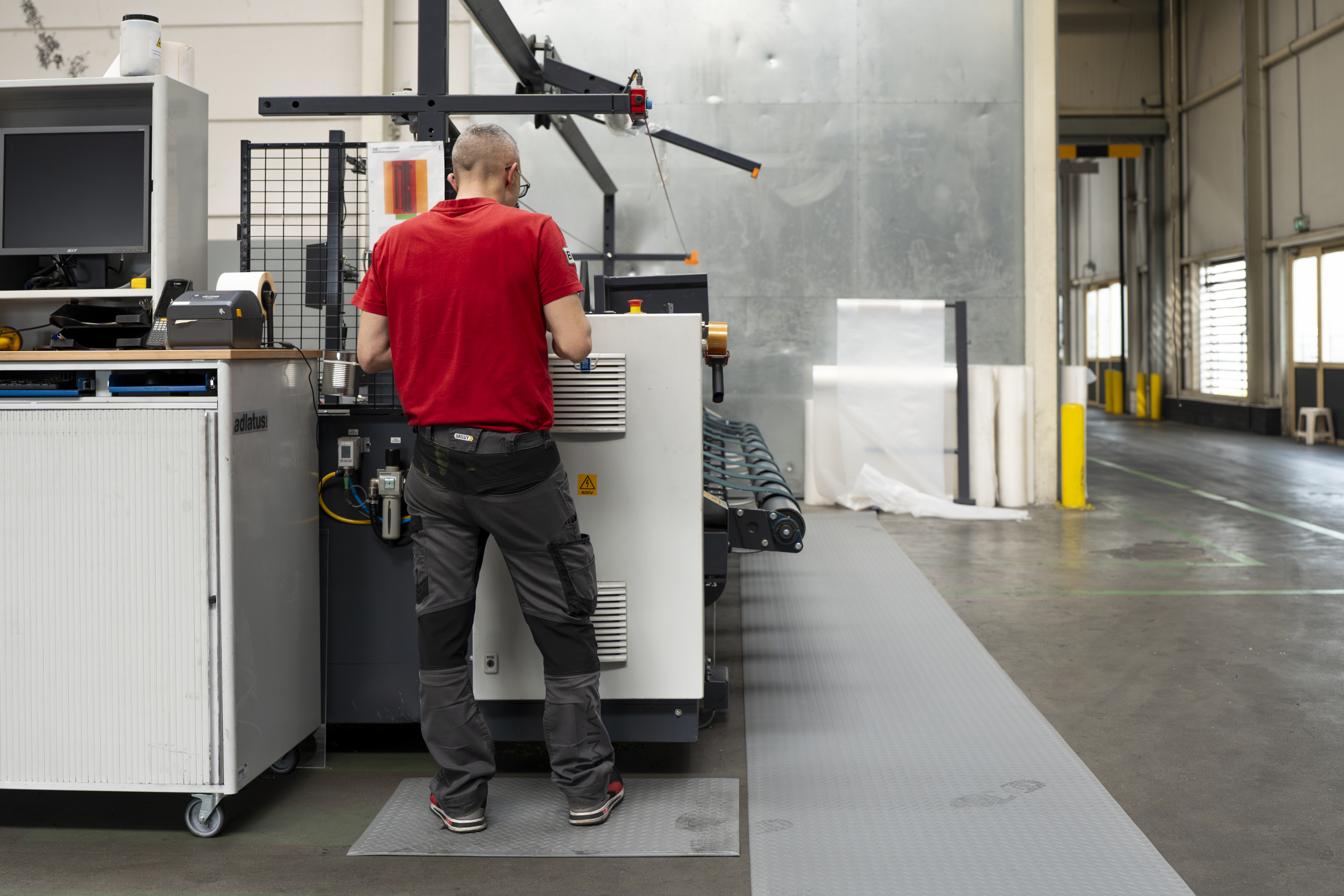
What does that say about your workplace?

If there is one figure that consistently appears in the reports of the Dutch Labour Inspectorate year after year, it is this: falls have been the most common type of workplace accident for years. The 2024 Workplace Accident Monitor examined 1,990 reportable accidents involving 2,001 victims 58 of whom died and found that falls accounted for 35 percent of all cases, followed by “contact with work equipment or an object” (31 percent). The picture was virtually identical the previous year, in 2023, when falls also accounted for 35 percent of the accidents investigated.

It raises an obvious question: if falls remain so stubbornly at the top of the list, what are we actually doing about it on the shop floor itself, where the problem begins?

Slipping is not the same as falling from a height, and that is precisely the point.

When the category of ‘falls’ is mentioned, people often think of dramatic accidents such as someone falling from scaffolding or a ladder, or crashing through a roof. While such serious accidents do occur particularly in construction, industry, and agriculture a large proportion of fall-related accidents stem from far less dramatic, everyday causes: slipping, tripping, or otherwise falling on the same level. Research by Statistics Netherlands (CBS) shows that this is the second most frequently cited cause of workplace accidents among employees, ranking immediately after ‘physical overexertion.’ For self-employed individuals, it is actually the leading cause, accounting for nearly a quarter of all cases.

Figures based on Statistics Netherlands (CBS) research bring this into even sharper focus: of the nearly 90,000 accidents in the Netherlands each year resulting in prolonged absence, 29 percent affecting over 26,000 employees involve a fall that keeps people off work for four days or more, almost invariably accompanied by physical injury. That is no insignificant residual category; it represents nearly one in three accidents leading to long-term absence.

International research confirms the significant role the floor plays in this regard. US figures, cited by companies such as NoTrax and MSC Industrial, show that slips and falls account for 20 to 30 percent of long-term workplace absences, with average costs exceeding $45,000 per injury claim when an incident occurs. This is precisely why floor safety is not treated as a minor detail in many occupational health and safety analyses, but rather as one of the most cost-effective points of intervention available: the floor is the single constant factor in every incident of this type.
Why specific workplaces in particular are at risk

Not every workplace carries the same level of risk, which is precisely why generic solutions often fall short. Moisture, oil, grease, and production residues are the usual culprits: on a slippery surface coated with a thin layer of liquid, friction between the shoe sole and the floor decreases often at the very moment someone is handling a fully loaded trolley, a serving tray, or tools, and is therefore less able to react quickly.

This also explains why certain industries are structurally overrepresented in accident statistics. The Labour Inspectorate identifies water utilities, waste management, the construction industry, and agriculture, forestry, and fishing as the sectors with the highest relative number of accidents all of which involve environments with wet, contaminated, or uneven floors. However, the hospitality, industrial manufacturing, and logistics sectors also share these exact same risk factors, albeit often indoors, making them less visible in national statistics regarding ‘falls from a height’.

What a mat does and doesn’t solve

An anti-slip mat is not a miracle cure that eliminates every risk; spills still need to be cleaned up, aisles must remain clear, and proper footwear remains important. However, within the hierarchy of controls adopted by occupational health and safety legislation, a mat represents a direct measure that addresses the hazard at the source precisely where the foot meets the floor.

The supporting evidence comes from an industry study tracking the installation of mats, which reported a 23 percent reduction in absenteeism over a two-year period, alongside a net productivity increase of 2.2 percent. A real-world example from the retail sector showed that a supermarket chain after installing open-structure, anti-slip mats with effective drainage in the fruit and vegetable section (historically a notorious hotspot for slips due to moisture and vegetable waste) saw the number of incidents in that area drop by more than 60 percent within a year.

The bottom line is this: a mat does nothing to change the source of moisture or dirt, but it does change what happens the moment a shoe sole comes into contact with that dirt.

What should you look for when choosing a non-slip mat?

Not every mat performs the same under the same conditions, and that difference is objectively measurable.

The R-value. The slip resistance of a surface is expressed in R-classes—for example, in accordance with DIN 51130—ranging from R9 (low slip resistance, dry environments) to R13 (very high slip resistance, suitable for floors that are consistently wet or greasy, such as in slaughterhouses or fish processing plants). A mat with an R-value that is too low for its environment creates a false sense of security: it appears to be a safety measure but actually performs inadequately.

Drainage and open structure. In areas where standing involves exposure to significant amounts of liquid such as kitchens, car washes, or slaughterhouses a solid mat often poses a risk, as liquid pools on the surface instead of draining away. An open or ribbed structure channels moisture to the underside, keeping the walking surface dry and ensuring good traction.

Securing the mat itself in place. An anti-slip mat that slides out of place under the weight of a footstep shifts the problem rather than solving it. A stable underside and the right dimensions for the walkway are therefore just as important as the surface itself.

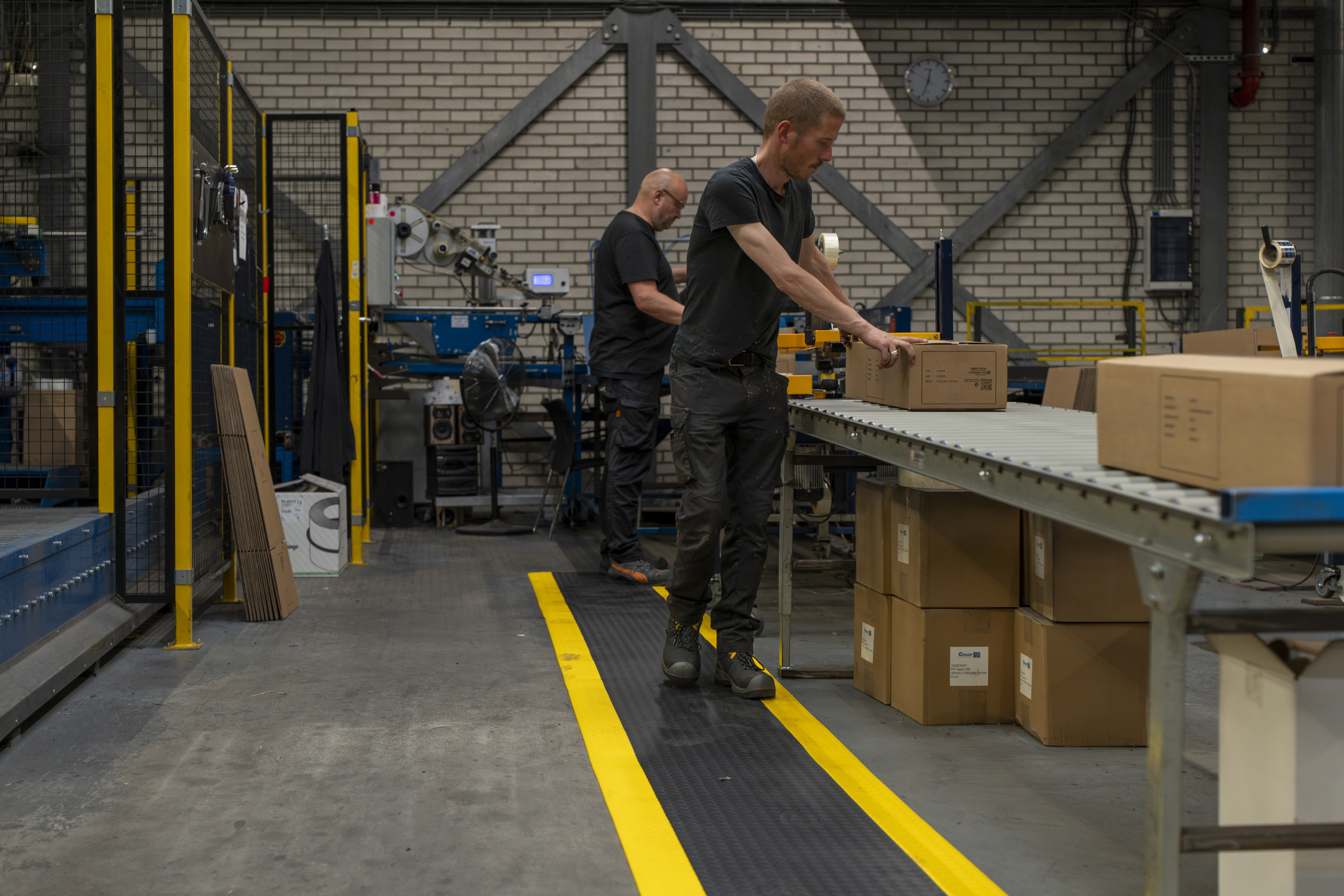
Chemical and visual signaling. In areas where oils or chemicals are present, resistance to these substances is important to prevent the material itself from softening or hardening. Furthermore, a clearly marked yellow-and-black border helps make the mat and thus the hazard zone visually stand out.

Here, too, independent certification makes the difference between a claim on the packaging and a verifiable characteristic. Base+ mats have been independently tested by TÜV Rheinland against standards such as ISO 10361, EN 16165, and ISO 6356; test results covering aspects such as slip resistance, wear resistance, and residual indentation are available upon request. The product range includes the Base+ Diamond and Base+ Pyramid featuring a yellow safety border for clear zone demarcation as well as variants specifically designed for oil resistance and grip in industrial environments.

The floor as a starting point, not an afterthought.

When drawing up a Risk Inventory and Evaluation (RI&E), the floor is often viewed merely as a given something already in place rather than an element involving a deliberate choice. Figures from the Labour Inspectorate reveal that this assumption overlooks the very point where most problems arise: at the level of the floor itself, in the ordinary, daily contact between foot and surface. With falls consistently topping accident statistics year after year, the floor should be seen not as the final detail of a safety policy, but as its starting point.

View the range of safety mats

Request the test data for well-founded advice.

Test data