Working while standing often seems harmless. After all, you are simply standing behind a counter, at an assembly line, or at a checkout; you aren’t lifting heavy loads, and there is no extreme physical strain. Yet, standing still for long periods on a hard surface is one of the most underestimated forms of physical strain. It is not caused by a single moment of heavy exertion, but by the cumulative effect of constant, minor pressure on the feet, legs, back, and circulatory system hour after hour, day after day.

What happens to your body when you stand still for a long time

When you walk, your calf muscles act like a pump: with every step, blood is squeezed upward from your lower legs back to the heart. However, if you stand still for an extended period, that pumping action largely ceases. Blood pools in your lower legs and feet, pressure remains constantly focused on the same points in your joints, and your muscles do not get a chance to recover between periods of exertion.

The result is a familiar pattern: after a while, noticeable discomfort develops in the feet, legs, and lower back, often accompanied by stiffness in the neck and shoulders. This effect occurs more quickly on harder surf acessuch as concrete, tiles, or industrial flooring and diminishes noticeably when there is a resilient, cushioned surface underfoot, like an anti-fatigue mat.

This pattern recurs frequently: in the hospitality and retail sectors, in production and assembly work, and in environments where people perform precision work while standing, such as operating rooms or workshops. Wherever prolonged standing in a relatively static position is the norm, similar complaints arise, and a better floor surface helps to alleviate them in every case.

Not everyone experiences this to the same extent. Some people are naturally more prone to developing lower back problems when working while standing than others. For this group, the choice of flooring makes a demonstrably greater difference, whereas those less susceptible to back issues generally notice a less pronounced effect. That does not mean a good floor surface is unnecessary for the others; it is primarily a matter of the degree of relief an individual experiences.
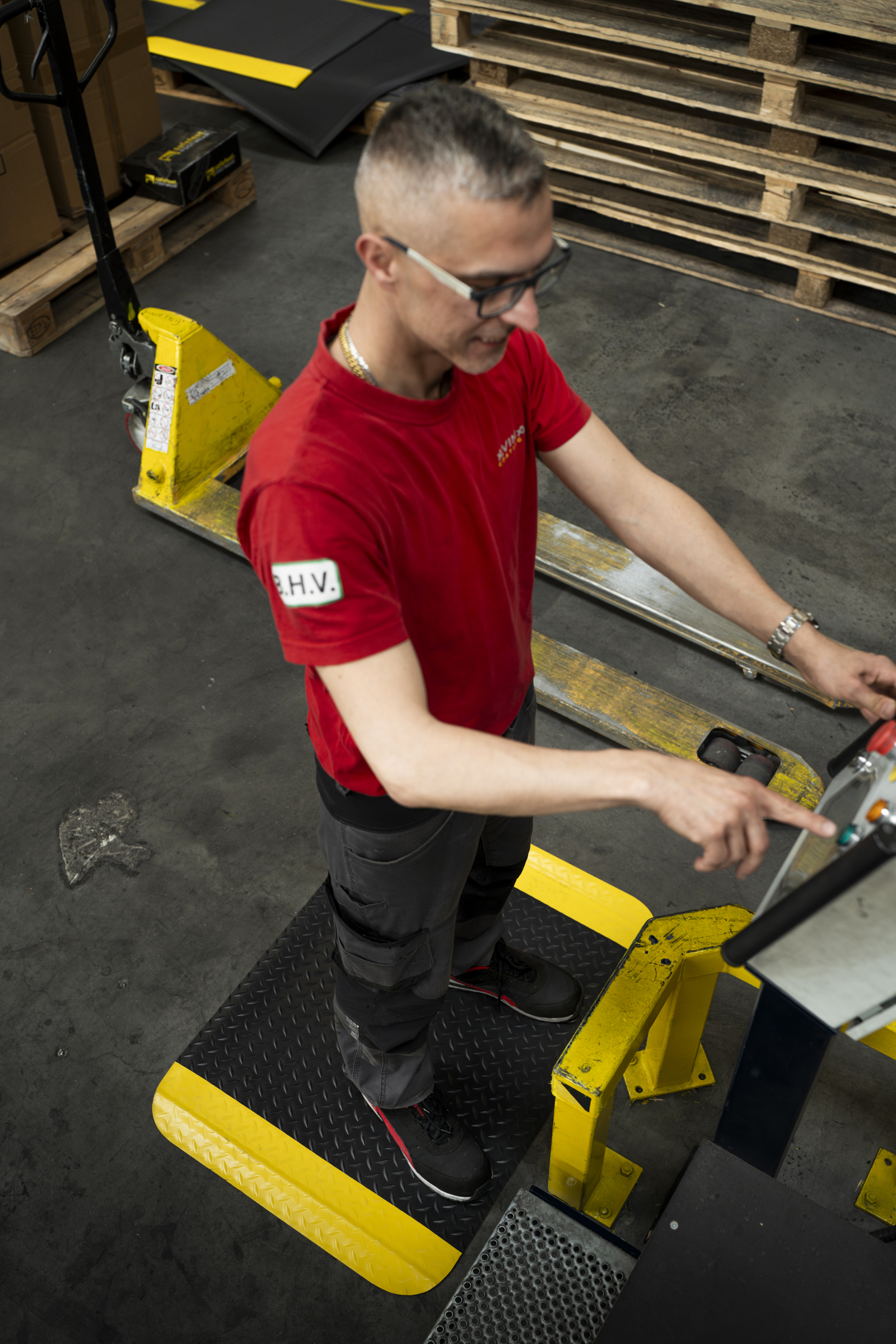
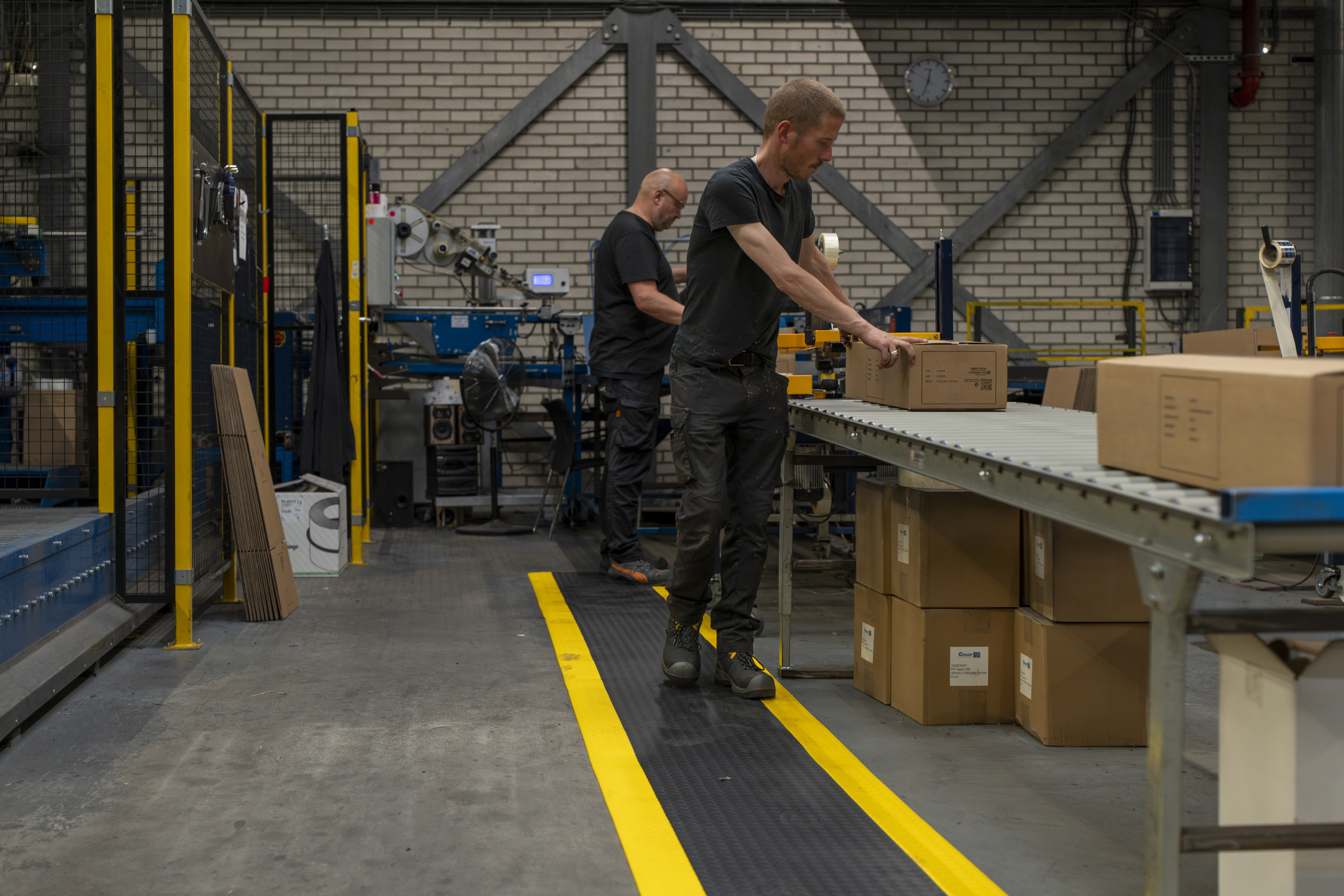
Why does a mat actually help?

The most common explanation is that a slightly springy, not entirely stable surface triggers continuous micro-movements in the feet and lower legs. These small, virtually unconscious movements keep the calf muscles active, supporting blood circulation and breaking the static posture that underlies fatigue. The effect, therefore, is not so much that a mat feels “softer,” but rather that it subtly keeps stimulating your body to make slight movements.

However, not every physiological parameter is equally straightforward to demonstrate; objective measurements such as leg volume or swelling yield inconsistent results in studies. Yet, the self-reported reduction in discomfort and fatigue is remarkably consistent: people feel noticeably better on a resilient surface than on a hard floor. The impact on comfort and fatigue is, therefore, the more solidly substantiated part of the story.

What does the law actually say about working while standing?

In the Netherlands, the Working Conditions Act does not contain specific rules regarding work performed while standing; it is a framework act that requires employers to design the workplace according to ergonomic principles without setting exact limits. However, standing work must be addressed in the mandatory Risk Inventory and Evaluation (RI&E), and if there is an elevated risk, the employer must include measures to address it in the accompanying action plan.

A number of sectors have further elaborated on that general standard themselves through an occupational health and safety catalogue. A widely used health guideline states that there:

  • Work may be performed while standing at the same workstation for a maximum of one hour at a time without a change in activity;
  • After that hour, there must follow at least 10 minutes of seated work, walking work, or a break;
  • Work involving standing may be performed for a maximum of 4 hours per day without sufficient variation.

In addition to job rotation and sufficient variety between standing, walking, and sitting, the Occupational Health and Safety Portal explicitly cites rubber mats or soft-soled shoes as measures to improve comfort for the back and legs—particularly on cold or hard surfaces. This positions the anti-fatigue mat not merely as an “extra,” but as a recognized component of a sound ergonomic policy—something that can be incorporated into your Risk Inventory and Evaluation (RI&E) and Action Plan.

Not all mats are the same: what should you look for?

If the underlying surface makes a demonstrable difference, the logical follow-up question is: exactly which surface? Not every rubber or PVC mat performs the same way, and that is precisely where product choice becomes relevant.

Important features to look out for:

Anti-slip performance. A mat that does not provide grip itself can actually increase the risk of slipping rather than reduce it. Anti-slip ratings indicate the slip resistance of a surface and are particularly relevant in wet or greasy environments, such as commercial kitchens or production facilities.

Shock absorption. A mat’s cushioning determines how much pressure is actually relieved from the joints and muscles. A mat that is too firm offers insufficient relief, while one that is too soft can cause instability; striking the right balance between the two is precisely what the material and thickness of a mat are all about.

Chemical and oil resistance. In industrial environments involving oils, greases, or chemicals, a mat must be resistant to degradation. A mat that begins to soften or harden after just a few months loses the very properties for which it was purchased.

Antistatic properties (ESD). In workplaces where electrostatic discharge poses a risk to equipment or processes, this is a requirement, not an afterthought.

Service life and maintenance. A mat that wears out quickly or is difficult to keep clean ultimately costs more than it is worth especially in high-traffic environments, such as production lines operating on a shift basis.

Properties of this kind cannot be accurately assessed by sight alone. Independent quality inspections and standards provide objective insight into wear resistance, slip resistance, and residual indentation, rather than relying on claims found only on the packaging. When purchasing mats, it is therefore wise to ask for test data instead of relying solely on appearance or price.

Why this is more than just comfort

It is easiest to view anti-fatigue mats simply as a comfort measure nice to have, but not essential. Reality, however, tells a slightly different story. Fatigue and pain caused by prolonged standing are linked to a loss of concentration, a slower work pace, and an increased risk of errors or accidents towards the end of a shift. From that perspective, a suitable flooring surface is an investment not only in well-being but also in productivity and safety precisely the two areas an employer’s risk assessment (RI&E) aims to safeguard.

At Base+, this translates into a range of over 30 mats in ten different versions from anti-slip and anti-fatigue mats to fluid-resistant options for more demanding industrial environments. The mats have been tested for factors such as wear resistance, slip resistance, and residual indentation, ensuring that your choice is based not on gut feeling, but on measurable properties that align with the specific risks in your work environment.

Whether it involves staff standing at a checkout for hours, a team working on a production line, or a workshop where oil and chemicals are present daily, the right mat tackles the problem at the source in line with the occupational health and safety strategy mandated by the Working Conditions Act, which prioritizes addressing the source before resorting to personal protective measures.


View the range of anti-fatigue mats

Request the test data for well-founded, tailored advice.

Test data